 Transdisciplinary Trickster
As a card-carrying academic, I am a purveyor of progressive pedagogy, a writer of gonzo scholarship, and a radical rhetorician who researches pop and counter culture. My publications reflect my delight in divergence and in collapsing the boundaries between what is and isn’t authorized under the elitist umbrella of academia.
What ultimately connects my writing, research, and thinking is a compulsive interest in the networked and negotiated spaces between people, places, and things—how, for instance, first-year writing students engage static academic modes amidst ever-shifting communication technologies, how neurodivergent writers negotiate neurotypical and ableist discourse expectations, and how comedy can both subvert and reify cultural norms.
Projects (past and present)
Rhetorical delivery and obscenity

Permeable Boundaries: Rhetorical Delivery and the Negotiation of Obscenity.
Dissertation. Northeastern University, 2015.
Permeable Boundaries demonstrates how transgressive culture, proves a fruitful site for the interrogation and rearticulation of rhetorical concepts, including delivery and kairos.
Underlying my investment in rhetoric and obscenity is an interest in the creation and negotiation of rhetorical spaces. My dissertation focuses on how kairos, decorum, and ethos facilitate understanding the challenges presented by communication technologies, especially with regard to the negotiation of digital boundaries and spaces. I plan (someday) to revise for publication the first case study based on feedback—and an amazing workshop at RSA with rhetorician Mary Stuckey. My chapter on FCC v. Pacifica and George Carlin has been cut up for parts and repurposed for the introduction to my Carlin book (see below). The rest? We’ll see…
Sexual iconography and visual rhetoric

The Multivalent Feminism of The Notorious Bettie Page
Jump Cut: A Review of Contemporary Media, vol. 55, 2013.
Writer and director Mary Harron remediates fifties pin-up legend and bondage queen Bettie Page in an effort to disrupt traditional representations of female sexuality and identity.
I have longstanding scholarly interests in feminisms and sexual iconography, and my work on 1950s pin-up queen Bettie Page, which began with my 2001 master’s thesis, “‘The Girl Who Made Good Being Bad’: Bettie Page and American Postwar Ideology,” led to the 2013 publication of my piece on Mary Harron’s biopic, The Notorious Bettie Page, in Jump Cut 55. I remain committed to projects that explore the complexities of sexual signification, and my long-range research plans include a book project that collects and connects my work on Bettie Page with my research into visual and digital rhetorics, exploring pin-up iconography as visual rhetoric for a future article, “Bunny Yeager and the Visual Rhetoric of Postwar Pin-Ups” (working title).
Rhetoric and stand-up comedy
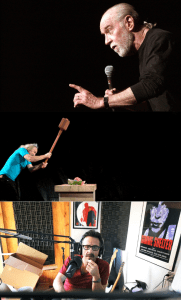
Disarming the Darkness: The Sobering Affect of Marc Maron’s Comedy. Co-authored with Lauren Hess. Stand Up Falling Down: Stand-Up Comedy, Addiction, and Mental Illness, edited by Linda Mizejewski and Robyn Warhol. TBD.
“It’s a hideous, hideous stupidity”: Gallagher’s Comedy of Contempt
The Journal of American Culture, vol. 45, no. 2, 2022, pp. 125-138.
“Like a Realtor in Peoria”: Patton Oswalt, Twitter, and Heckling as Social Activism
Studies in American Humor, vol. 6, no. 1, 2020, pp. 62-90.
Marc Maron as Philosopher: Comedy, Therapy, and Identification
The Palgrave Handbook of Popular Culture as Philosophy, edited by David Kyle Johnson, Palgrave, 2021. https://doi.org/10.1007/978-3-319-97134-6_52-1
“I Kinda Like It When A Lotta People Die”: George Carlin’s Comedic Catharsis
The Dark Side of Stand-Up Comedy, edited by Eric Shouse and Patrice Oppliger, Palgrave, 2020, pp. 51-70.
“Phil Hartman” and “Marc Maron”
American Political Humor: Masters of Satire, edited by Jody Baumgartner, 2019, pp. 446-451; 536-540.
Review of The Comedy Studies Reader, edited by Nick Marx and Matt Sienkiewicz
Studies in American Humor, vol. 6, no. 1, 2020, pp. 208-212.
Review of All Jokes Aside: Standup Comedy is Phunny Business
Studies in American Humor, vol. 3, no. 2, 2017, pp. 251-253.
Inspired by my 2012 Tufts University Experimental College course on rhetoric and stand-up comedy (Analyzing Stand-Up Comedy: Laughter, Language, and Rhetoric), I have pursued a number of projects where stand-up comedy intersects rhetoric. I am interested in how stand-up engages audiences in cultural critique that often crosses borders of taste and correctness. How does stand-up, as a performed, semi-public rhetorical act, engage, agitate, and/or reify audience belief networks? Is stand-up a means by which subgroups and counterpublics might forward a rhetoric of agitation? These lines of inquiry marry my interests in subcultures, “dirty words,” and the negotiation of rhetorical and compositional spaces.
For MLA 2016, I organized and presided over a special session panel entitled “The Cultural and Rhetorical Work of Stand-Up Comedy.” A first of its kind at MLA, this panel spoke to both emerging interest in and the relevance of stand-up as a site of scholarly inquiry.
My subsequent affiliation with the American Humor Studies Association has led to a number of exciting research opportunities. In the fall of 2016 I presented as part of the Humor Studies Caucus panel (Bringing Down the House: Re-Centering the Histories of Humor and Comedic Performance) at the American Studies Association Annual Convention in Denver, Colorado (“Betting on Black“). My paper on comedian Patton Oswalt (“Like a Realtor in Peoria”: Patton Oswalt, Twitter, and Heckling as Social Activism) was selected for the AHSA’s 2018 MLA panel. This conference paper became the article which appeared in Studies in American Humor vol 6.1.
My paper on George Carlin’s controversial bit, “I Kinda Like It When a Lotta People Die,” was part of a plenary session at the 2017 International Society for Humor Studies conference in Montreal. The final version of this paper appears in The Dark Side of Stand-Up Comedy, a collection of essays (Palgrave MacMillan) edited by panel organizers Eric Shouse and Patrice Oppliger.
In spring 2017, I was invited to participate in Bucknell University’s “Ethics and Aesthetics of Stand-Up Comedy Conference.” After a long gestation period, I turned the paper I presented at Bucknell into “It’s a hideous, hideous stupidity”: Gallagher’s Comedy of Contempt, which appeared in the June 2022 issue of Journal of American Culture.
Finally, and most importantly, I am working on a monograph on George Carlin (working title American Bullsh!t: The Rhetorical Genius of George Carlin). I presented a version of a future chapter (“Memory, Performance, Disaster: George Carlin’s ‘I Kinda Like it When a Lotta People Die'”) at the 30th Annual Conference on American Literature in Boston, MA (as part of a panel sponsored by AHSA), and the beginnings of another chapter (“Baseball and football”: Arrangement and distortion in a George Carlin joke”) at the 2023 Comedy/Humor joint conference of the American Humor Studies Association (AHSA) and Comedy Studies SIG of the Society For Cinema and Media Studies (SCMS).
Science fiction and law

“The Circle Must Be Broken”: Imagining Legal Monsterhood through Doctor Who. Cultural Legal Studies of Science Fiction, edited by Kieran Tranter, Mitchell Travis, and Alex Green. Routlege, 2024.
“What a Glorious Moment in Jurisprudence”: Rhetoric, Law, and Battlestar Galactica
Law, Culture and the Humanities, vol. 12, no. 3, 2016, pp. 543-565.
“I Don’t Feel Like A Copy”: Posthuman Legal Personhood and Caprica
Griffith Law Review, vol. 23, no. 4, 2014, pp. 612-633.
My investigation of science fiction television has found an outlet in interdisciplinary law and humanities scholarship—and has resulted in two publications: “‘What A Glorious Moment in Jurisprudence’: Rhetoric, Law, and Battlestar Galactica” in Law, Culture, and the Humanities; “‘I Don’t Feel Like a Copy’: Posthuman Personhood and Caprica” in the Griffith Law Review. This work, which grew out of my doctoral studies in rhetoric and law, has found a home with law and humanities scholars interested in science fiction as a site for exploring jurisprudence.
With current debate raging about the exponentially expanding role of A.I. in text, code, and image generation, the points I raised about legal personhood nearly ten years ago in my Caprica article are (not surprisingly) even more relevant and pressing. I am currently revisiting “I Don’t Feel Like a Copy” and hope to produce a “ten years later” update alongside a published discussion with leading scholars of law and technology. This work has also inspired me to produce a new piece of scholarship for an edited collection on cultural legal studies of science fiction. This new piece takes as its object of study the Ood, a telepathic, nonhuman species introduced to the Doctor Who universe in 2006, and suggests a possible, arguably necessary, path toward a human law that recognizes and ethically adjudicates the beauty of the nonhuman monster.

 stevenkapica.com